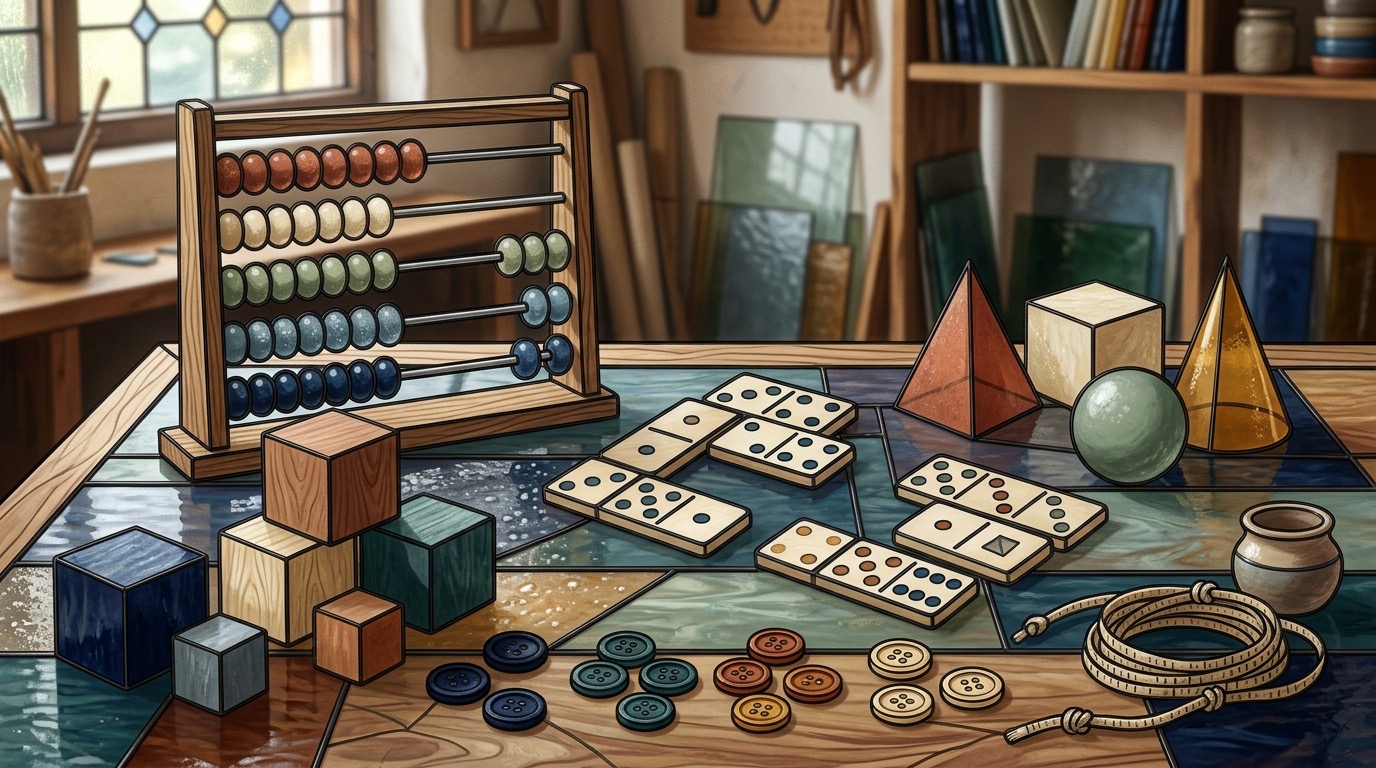
Number sense is the flexible understanding that tells us five objects remain five when rearranged, that twelve is close to ten, that two groups can be compared, and that an answer is unreasonable before any formal correction appears.
Talk about quantity before reaching for a rule
When an adult asks only for an answer, a learner can hide a fragile understanding behind memorized steps. Ask what the quantity is doing. Is it growing, shrinking, being shared, grouped, measured, repeated, or compared? Physical objects make these actions visible.
Buttons, beans, blocks, socks, spoons, bottle caps, and stones can become temporary mathematical tools. Arrange the same collection in a line, circle, and tight cluster. Ask whether the amount changed and how someone could check without starting over. The conversation matters more than having special manipulatives.
Build estimation into ordinary moments
Estimation is not careless guessing. It is a reasoned expectation. Before counting, measuring, or timing, invite a prediction and a reason: “Do you expect this bowl to hold more or less than the cup?” “Is the walk likely closer to five minutes or thirty?” “About how many handfuls might fill the jar?”
After finding the actual result, compare it without grading the estimate as good or bad. Ask which clue was useful and what the learner would change next time. This develops magnitude and judgment.
Try this: choose, estimate, check, explain
Choose one household quantity: forks for the table, steps across a room, cups of water in a pitcher, or books on a shelf. Estimate, check with a sensible method, then explain why the result does or does not make sense. Stop after one example.
Use grouping to make large amounts easier to see
People rarely count large collections one item at a time. We make equal groups, use landmarks, and recognize patterns. Invite a learner to organize a mixed collection so another person can see the total quickly. Groups of two, five, or ten may emerge, but do not require one method before exploration.
Ask, “What does your arrangement make easy to notice?” Another arrangement might highlight pairs, leftovers, symmetry, or repeated rows. Comparing representations shows that mathematical structure can be chosen for a purpose.
Let the kitchen provide meaningful constraints
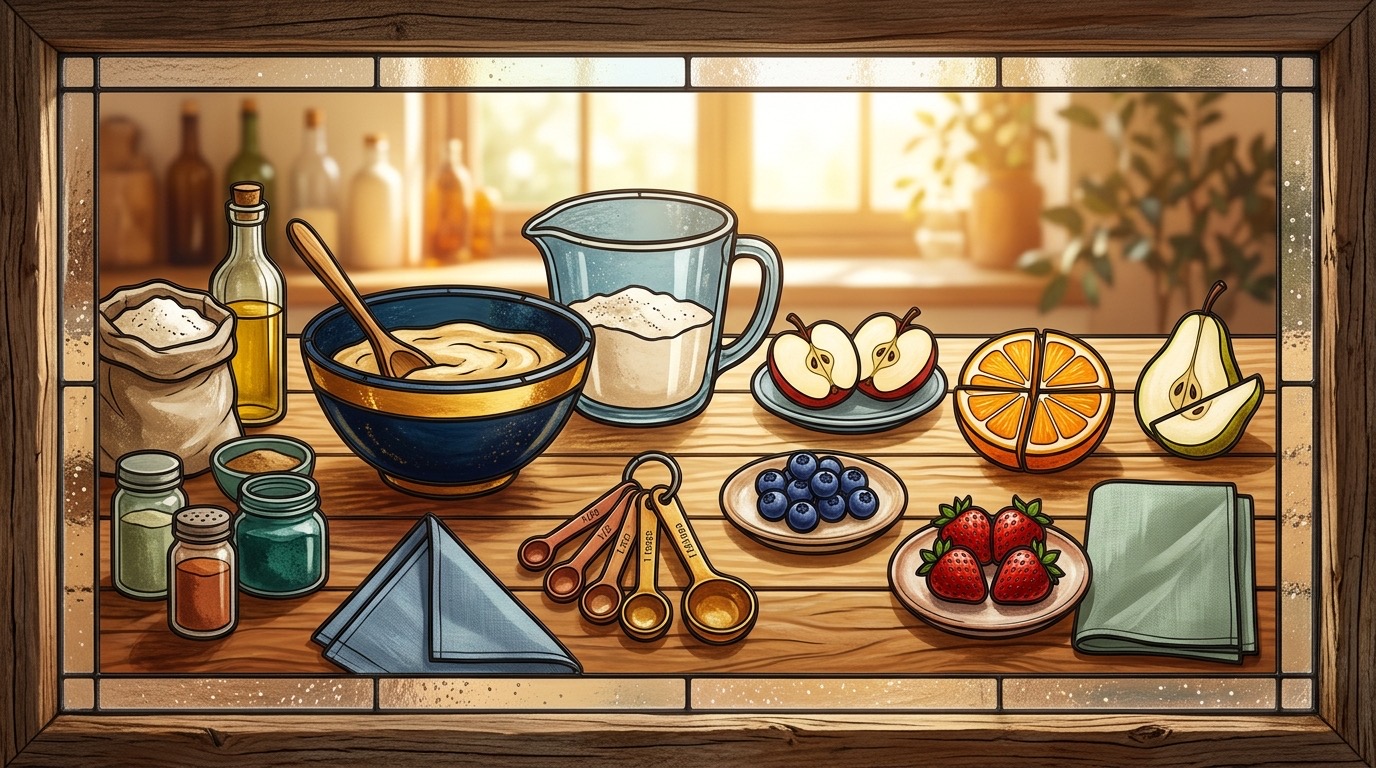
Recipes and shared food create authentic questions. How can equal portions be made? Which container is large enough? What could be doubled safely? How many place settings are needed? Adults should supervise heat, blades, appliances, allergies, and food handling, while learners take an appropriate role.
The goal is not to attach a worksheet to cooking. Name the mathematics already present. “We need the portions to be fair.” “This container is wider but shorter.” “We used half, so what remains?” A brief observation can be more powerful than turning the whole activity into a lesson.
Ask for reasoning in more than one form
A learner may explain by speaking, drawing, moving objects, pointing, or demonstrating a second method. Instead of “How did you get it?”—which can sound like suspicion—try “Show me how you saw it.” Adults can then share another strategy as an addition, not a replacement.
- What did you notice first?
- Which amount is a useful landmark?
- Can you make the same total a different way?
- What would change if one group were added or removed?
- How could another person check this efficiently?
Keep pressure low
Speed and understanding are not the same. Timed recall may create stress that hides what a learner knows. Use short playful rounds only when the learner is comfortable, and protect plenty of untimed opportunities to reason.
Notice progress that does not look like a score
Look for estimates becoming more reasonable, groups becoming more purposeful, explanations becoming clearer, and mistakes being noticed independently. A learner who says, “That cannot be right because the answer should be near twenty,” is showing valuable number sense even before finding the exact result.